The short version
- Council tax: about £155 to £245 a month on most family homes, set by the property's band and the council. It is usually billed in ten monthly instalments, not twelve.
- Energy: about £100 a month for a small flat to about £200 for a large house at this winter's price cap. Older houses can run higher.
- Food: about £320 a month for a couple, £425 for a family of four and £520 for a family of five, on the latest official figures.
- Water £53, TV licence £15, phones and broadband around £100 to £120. A car adds about £68 a month before a drop of fuel.
- On a visa, add the immigration health surcharge: £1,035 a year for each adult and £776 for each child, paid up front.
Cost of living calculator
Monthly household bills in England, before rent, from official averages.
That is the UK average. Newcomers with no UK driving record are often quoted far more in year one.
Fuel on top: a 50-litre tank costs about £87 at 174.9p a litre (5 October 2026).
Paid up front for the whole visa, shown here as a monthly equivalent.
Before rent, fuel, childcare, clothing and eating out.
Averages from official sources, dated. Your bills depend on the property, the council and your suppliers. For rent and the cash before the keys, use our rent and salary calculator.
These are national averages. Your Blueprint works it out for the actual areas and homes you are looking at.
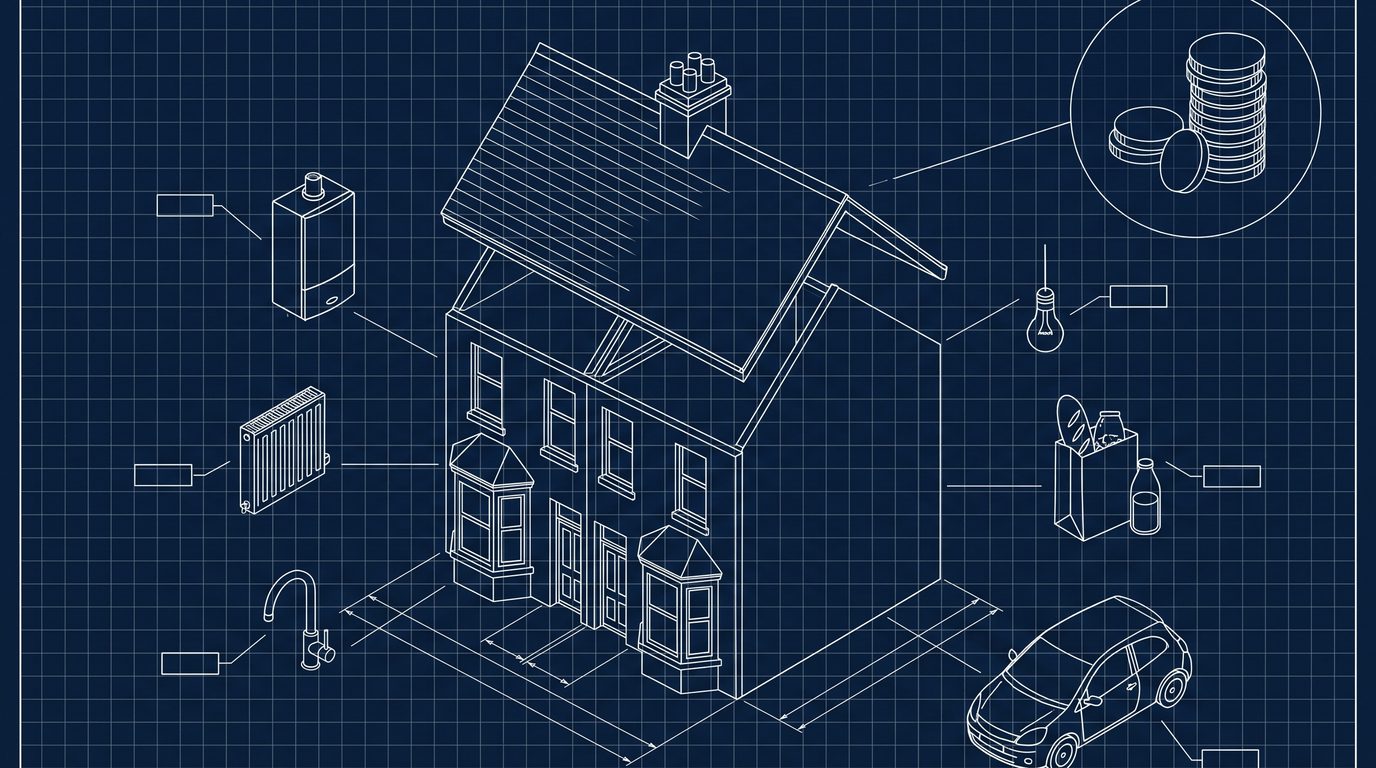
The bills, line by line
The table gives each bill for three kinds of home: a small flat, a two-to-three-bedroom house and a four-bedroom family house. Energy follows Ofgem's low, medium and high usage levels at the price cap for October to December 2026; council tax uses the England average for bands B, C and E; food and phones use the Office for National Statistics' spending figures for a couple, a family of four and a family of five.
| Monthly, before rent | Couple, flat | Family of four, 2–3 bed | Family of five, 4 bed |
|---|---|---|---|
| Council tax | £155 (band B) | £177 (band C) | £244 (band E) |
| Gas and electricity | £101 | £144 | £202 |
| Water | £53 | £53 | £53 |
| Food and drink at home | £317 | £426 | £518 |
| Phones, broadband and post | £100 | £118 | £117 |
| TV licence | £15 | £15 | £15 |
| Car (insurance, tax, MOT) | none | £68 | £68 |
| Total before fuel | £741 | £1,001 | £1,217 |
Fuel is the one line no table can set for you. Petrol was 174.9p a litre in early October 2026, so a 50-litre tank costs about £87. Two tanks a month takes the family of five to about £1,390.
Council tax: the bill nobody warns you about
Every home in England sits in one of eight bands, A to H, and the council sets a Band D figure that every other band is a fixed fraction of. The England average Band D bill for 2026–27 is £2,392 a year; a Band A home pays two-thirds of that and a Band H home twice it. London is cheaper than you would expect, at an average Band D of £2,068.
Two things catch newcomers. The bill is usually split into ten monthly payments, so a £2,392 bill is £239 a month for ten months, not £199 for twelve. And in most lets it is the tenant's bill, not the landlord's, from the day the tenancy starts. Every listing should show the band; ask for it before a viewing, the same way you ask for the rent.
Energy: the house matters more than the tariff
The price cap sets the maximum unit rates and standing charges, not your bill. At the October to December 2026 cap, a household using Ofgem's medium amounts, 2,500 kWh of electricity and 9,500 kWh of gas a year, pays about £1,723. A high user, the large family house, pays about £2,424.
In sixteen years of lettings, the thing that moves the energy bill most is the building, not the supplier. A draughty Victorian terrace with single glazing costs far more to heat than a modern flat of the same size. Rented homes must have an Energy Performance Certificate, rated A to G; a D or E rating is common in older stock, and it is worth asking for before you commit.
Food: closer to the rest of Europe than to the US
The latest ONS figures, for April 2024 to March 2025, put average spending on food and soft drinks at home at £73.20 a week for a working-age couple and £119.60 for a couple with three or more children. Monthly, that is about £317 and £518. Food spending barely moves with income: over the three years to March 2025, the lowest-earning fifth of working-age couples spent £61.60 a week and the highest £75.60. What changes with income is eating out.
The costs only newcomers pay
The health surcharge comes first, because it is due before you travel. If you are coming on a visa, the immigration health surcharge is paid up front with the application for the whole length of the visa: £1,035 a year for each adult and £776 for each child. A family of two adults and three children on a five-year visa pays nearly £22,000 in a single payment before arrival. Spread over the visa that is about £367 a month, but it is not paid monthly.
Car insurance is the second. The average UK premium was £560 in early 2026, but that is for drivers with years of UK no-claims history. Many insurers do not credit an overseas driving record, and the Americans I know who have made the move were quoted closer to £100 a month in their first year. The third is the cash before the keys: a holding deposit, a five-week tenancy deposit and the first month's rent, all due before you move in. Our guide to what rent you can afford works it out.
Compared with home: what is cheaper, and what catches people out
Some things cost less or nothing. State schools are free, including at secondary. NHS care is free at the point of use once you are resident.
Other things cost more than people expect. Council tax, above, is the big one. The TV licence, £180 a year, is needed to watch live television or use BBC iPlayer. And water is a separate bill from a water company, usually not included in rent. If you are coming from the United States, our cost of living comparison for the UK and the US sets the same bills side by side.
Where the general rule stops
These are averages, and no family is average. Council tax depends on the exact council and band; water on your supplier and whether you are metered; energy on the building and how warm you keep it; insurance on your age, car, postcode and history; food on how you shop. The ONS figures are also a year and a half behind prices, so food will cost a little more than the table shows. And none of this includes rent, childcare, clothing, holidays or eating out, which for most families are the larger numbers.
How Moovedin can help
The free scorecard takes four minutes and checks your budget against what the area you are moving to actually costs. The Blueprint is a written plan of your whole move, drawn up for your household: the areas that fit your budget and commute, the rent and bills you should expect there, and what to sort before you fly. It costs £99 and includes WhatsApp support from the Moovedin team until two weeks after you move in. Where your situation needs a judgement call, a call with me costs £79. Whichever you choose, ask for the council tax band and the EPC rating before every viewing. They are the two numbers that decide most of your bills.
Frequently asked questions
How much does a family moving to the UK need a month, excluding rent?
For a family of four in a two-to-three-bedroom house, about £1,000 a month on the core bills, plus fuel, clothing and everything else. For a family of five in a larger house, about £1,200 before fuel.
How much is council tax a month?
It depends on the band and the council. The England average Band D bill for 2026–27 is £2,392 a year, usually paid in ten instalments of about £239. Bands A to C are lower, E to H higher.
How much is the average energy bill in the UK?
At the price cap for October to December 2026, a household with medium usage pays about £1,723 a year, roughly £144 a month. A large family house can be around £2,400.
Is food expensive in the UK?
Less than many newcomers expect. A working-age couple spends about £73 a week on food and soft drinks at home, and a family of five about £120, on the latest official figures.
Do I have to pay for the NHS if I move to the UK?
Not at the point of use once you are resident. If you are coming on a visa, the immigration health surcharge is paid up front with the application: £1,035 a year per adult and £776 per child.
Our area guides
Our area guides cover twelve English cities, three areas each, with current rents and what to check before you view: Manchester, London, Leeds, Birmingham, Liverpool, Bristol, Sheffield, Newcastle, Nottingham, Cambridge, Oxford and York.
Sources
- Family spending in the UK: April 2024 to March 2025, and Family spending workbook 2: expenditure by income, tables A23 and A29, Office for National Statistics. https://www.ons.gov.uk/peoplepopulationandcommunity/personalandhouseholdfinances/expenditure/bulletins/familyspendingintheuk/latest. Released 11 June 2026, accessed 27 October 2026. Weekly food and communication spending by household type; monthly figures are weekly × 52 ÷ 12.
- Changes to energy price cap between 1 October and 31 December 2026, Ofgem. https://ofgem.gov.uk/news/changes-energy-price-cap-between-1-october-and-31-december-2026. Published 26 August 2026, accessed 27 October 2026. Unit rates and standing charges; the £1,723 typical bill.
- Review of typical domestic consumption values: decision, Ofgem. https://www.ofgem.gov.uk/sites/default/files/2026-05/Review%20of%20typical%20domestic%20consumption%20values%20decision.pdf. Published 27 May 2026, accessed 27 October 2026. Low, medium and high usage from 1 July 2026; the low and high bills are calculated from these at the October cap rates.
- Council Tax levels set by local authorities in England 2026 to 2027, GOV.UK. https://www.gov.uk/government/statistics/council-tax-levels-set-by-local-authorities-in-england-2026-to-2027. Released 25 March 2026, accessed 27 October 2026.
- Local Government Finance Act 1992, section 5, legislation.gov.uk. https://www.legislation.gov.uk/ukpga/1992/14/section/5. Accessed 27 October 2026. The band proportions.
- Paying your Council Tax bill, GOV.UK. https://www.gov.uk/council-tax/paying-your-bill. Accessed 27 October 2026. Ten monthly payments.
- Water bills for 2026–27, Water UK, as reported by MoneySavingExpert. https://www.moneysavingexpert.com/news/2026/01/water-bills-april-rise/. Published 29 January 2026, accessed 27 October 2026. Average bill £639 for England and Wales.
- Cost of TV Licence fee set for 2026/27, GOV.UK. https://www.gov.uk/government/news/cost-of-tv-licence-fee-set-for-202627. Published 6 February 2026, accessed 27 October 2026.
- Petrol and diesel prices, House of Commons Library briefing SN04712. https://researchbriefings.files.parliament.uk/documents/SN04712/SN04712.pdf. 6 October 2026, accessed 27 October 2026. Average petrol 174.9p a litre on 5 October 2026.
- Motor premiums remain stable, Association of British Insurers. https://www.abi.org.uk/media-hub/news-post/motor-premiums-remain-stable-but-cost-of-repairs-still-high. Press release 30 April 2026, accessed 28 October 2026. Average premium £560, Q1 2026.
- Vehicle tax rate tables, GOV.UK. https://www.gov.uk/vehicle-tax-rate-tables. Accessed 27 October 2026. Standard rate £200.
- MOT test fees, GOV.UK. https://www.gov.uk/getting-an-mot/mot-test-fees. Accessed 27 October 2026. Maximum £54.85 for a car.
- Pay for UK healthcare as part of your immigration application, GOV.UK. https://www.gov.uk/healthcare-immigration-application/how-much-pay. Accessed 27 October 2026. £1,035 a year, £776 for under-18s.
- The point that the building moves the energy bill more than the supplier is the author's account from sixteen years of lettings practice.
- The first-year car insurance figure of about £100 a month is the author's account from Americans he knows who have moved to the UK. It is not a survey figure; quotes vary widely by age, car and postcode.
Prices change. Check the live source for any figure before you rely on it.
This article is general guidance only. It explains typical household costs in England for people moving from abroad, using official averages; it is not a budget for your household. Your bills will depend on the property, the council, your suppliers and how you live.